Showing posts with label prayer. Show all posts

Sunday, December 23, 2012

When Caleb Went Missing


But Jesus said, “Let the little children come to Me, and do not forbid them; for of such is the kingdom of heaven.”

Matthew 19:14

 
It’s taken me months to write about this. In fact, it was so upsetting to me that I didn’t even journal about it. But in light of this nation’s recent tragedies, I think it’s time to share my brush with child loss that occurred sometime this last summer.

 
It was a beautiful, blazingly hot day, I think sometime in August. My youngest son, Caleb, and I decided to head to Keizer Rapids Park, the nearest hiking opportunity.   We both love to hike, especially if there’s some water involved, which at this park is the Willamette River.  There’s also lots of foliage and ample places for evil to lurk and hide. Of course such a suspicious thought didn’t occur to me until after I couldn’t find Caleb.

 
The Dirt Slide

We were at the back part of the park nearing the edge of paved portion of the trail. The pavement gave way to dirt paths strewn with river rock and tall, brown grasses growing along the sides of the path. Just before the pavement ends was a side trail, it was dirt and very steep but relatively short. It led to a landing very close to the river’s edge. Caleb wanted to go down this trail because it looked like fun. And why not, it was like a natural slide, what little boy wouldn’t want to slide down such a cool dirt slide. I figured it was okay and I’d follow right behind him. However, kneeling down to ready myself for the slide, my neck ached reminding me that such a jaunt would be unwise with a tender triple fusion. So I told Caleb to stay right where he was at the foot of the path while I went around to a less challenging path not 30 seconds away.

 
“Okay, Dad,” he said.

 
So I hustled off to the other path that cut through a dense blackberry thicket and came out right where Caleb should have been.

 
But he was gone.   

 
At first I was perturbed thinking he was just hiding somewhere, but he was nowhere to be found in the nearby bushes. I quickly scanned the landing area and saw nothing but grass, dirt, and the river. Now the first tendrils of panic started tugging at the fringes of conscious thought. I wanted to yell out his name but didn’t, thinking that if he were safe I didn’t want to alert any would-be pedophiles that a little boy was running around unattended.

 
I shot up the steep path, slipping, falling, and clawing my way to the top. Nothing, no Caleb. I ran the steps I had trod thinking maybe he misunderstood my instructions and followed me down the other path. But circling back to where he should have been again turned up nothing.

 
Not My Child

Now I began fighting back visions of calling in an Amber Alert. Not my little boy, not my family, no way, this is not happening! I rebuke those thoughts. Still they kept flashing like sinister light bulbs of a demonic paparazzi. Amber Alert, Amber Alert, Amber Alert…

 
Statistically I know that the first 20 minutes of a child abduction are the most critical.  So far I calculated we had clicked off five minutes and still no blonde haired, hazel eyed little boy. I ran to the river’s edge but saw and heard no thrashing. There was a teenage boy on a rocky outcropping looking like he was crawdadding.  I called out to him.

 
“Hey, hey you,” he looked my way. “Have you seen a little blonde boy running along the edge?” I’m sure he could hear the desperation in my voice.

 
“No, man; sorry. Haven’t seen anyone ‘cept you.”

 
“Okay, thanks.”

 
Oh God, I need You now..WHERE IS MY LITTLE BOY?? You’ve got to help me!!


Panic was becoming very real now through a pounding pulse, sweaty palms and horrible thoughts of what evil could be unleashed on such an innocent soul. “No,” I screamed to myself. I had to stay calm; I had to stay as focused as possible if I had any hope of seeing my little boy alive and in my arms again.

 
Along with agonizing prayer I also had a Building 429 lyric repeating in my mind; for some reason, I found the lyric calming, helping me remain focused on the unfolding tragedy:
 

“All I know is I’m not home yet/This is not where I belong. Take this world and give me Jesus/This is not where I belong.”

 
Another refrain from the song also echoed over the Amber Alert fears:

 
“When the earth shakes, I wanna be found in You/When the lights fade, I wanna be found in You.”

 
I started running down all the nearby paths, but there were so many, how was I to choose the right one? If I took path A and the pedophile took path B, I may very well never see Caleb again. O God, where do I go?

 
I broke down and started yelling his name at the top of my lungs, “Caleb, Caleb, where are you? Caleb?” I figured bad guys might now know he’s unattended but then so would any good guys—if there were any. Normal adults are always willing to help a lost child, aren’t they?

 
Mom

Coming up on fifteen minutes and still no Caleb I was confronted with the crushing decision to call the police, or worse, Janey (my bride and Caleb’s Mom). It was the worst phone call I’ve ever had to make.

 
“Hello,” she answered in her typically sweet voice. I’m sure she was expecting to hear that we had a good time and were heading home. Instead, she heard,

 
“We’re still at Keizer Rapids and Caleb’s missing.”

 
“What?! What do you mean?”

 
I was running down different paths while talking to her, so my voice was breathless and jerky. “I mean we got separated and I can’t find him. He’s missing and I can’t find him.”

 
What would you do if you got this phone call? Right in the middle of grocery shopping with her mother she dropped everything, “I’m coming there right now.”

 
“Okay, if he isn’t with me by then, we’ll have to call the police.”

 
Silence, she was on her way.  So I kept running down forest lined trails and grass lined trails. I went near the river hoping not to find a body and then running back toward the forested area of the park.
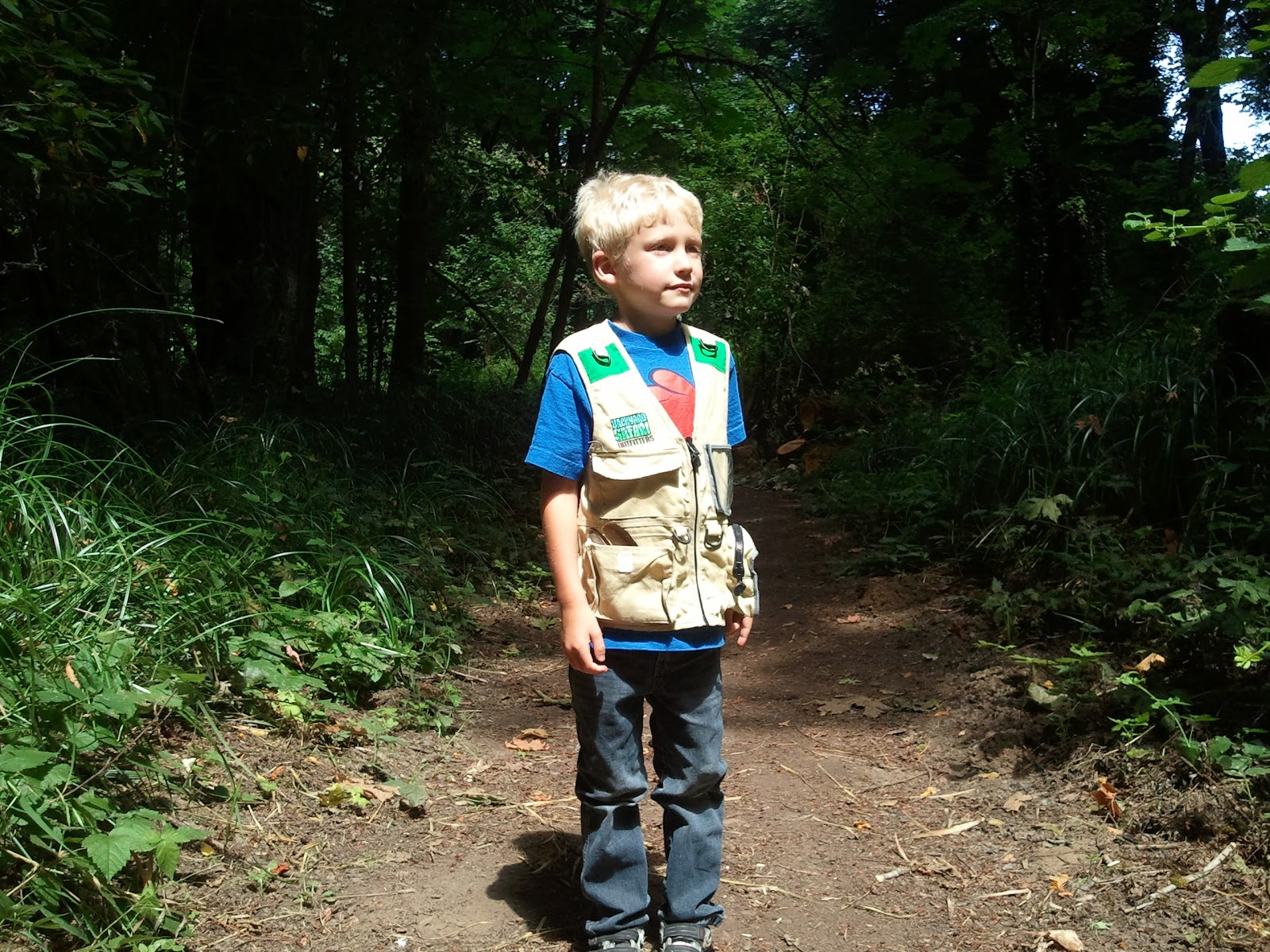
 

Breathless, I came up to a woman on the paved path walking her large dog.

 
“Have you…have you seen a little blonde boy with an explorers vest on,” I panted.

 
Pulling her dog a little closer she said, “Yeah, I saw him near the parking lot. He smiled and said ‘hi’ to me. …”

 
She kept talking but I started sprinting, calling a quick “Thank you” over my shoulder as I quickly decided which trail was the quickest to parking lot, which was close to a mile away.

 
Now because of my neck fusion, I don’t sprint anymore, it’s too much jolting on the fusion site; but fusion be damned, I sprinted faster than I’ve probably ever sprinted before. Panting and sweating, I was also yelling his name, “I’m coming Caleb, Daddy’s coming.”


Sweet Reunion

Rounding past the last corner on side of the amphitheater I saw him at the top of the grassy hill bordering the back part of the theater bowl. Seeing me he started running my way—his eyes wide with fright. I grabbed him, hugging him as hard as I safely could without knocking him over or squeezing his air out. He was sobbing, I was sobbing.
 

“I’m sorry, Daddy, I’m sorry,” he gasped, his little body shaking in my arms.

 
“It’s okay, Caleb, it’s okay. We’re together now, we’re together now; praise God.”
 

We hugged and cried. People walking by just stared at us, having no clue about the drama that had been playing out right under their noses. I called Janey, a wonderful, relieving phone call!
 

“I FOUND HIM,” I yelled into her ear.
 

She started crying along with Caleb and I. What a site we were, father and son sobbing into an Android!

 
She was still going to come to the park but I told we were going to get the heck out there and come home, so we’d all meet back up there. Once home we all hugged and sobbed right there in the drive way under the sweltering August sun. Finally catching my breath I went inside and collapsed on the couch, completely spent.

 
I will never think of parenting the same again. It is a privilege. Now I have a deeper understanding of the Psalm:
 

Behold, children are a heritage from the Lord, the fruit of the womb is a reward.

̶ Psalm 127:3

 
I’m also reminded of Romans:
 

Weep with those who weep.

̶ Romans 12:15b

 
I tell this story to encourage and inspire parents to love your children. It isn’t pampering or coddling, it is loving them, blessing them, teaching them, cherishing them. For as we all know, some of our brothers and sisters have recently lost their children in the most unimaginable way. And part of my story is to help us begin to grasp even a wisp of the emotions and pain these parents are feeling in the depths of their loss. 

 
In light of their unimaginable loss, one thing we can do is to love our children all the more. Those that commit domestic violence—stop! Those who ignore or withdraw—get engaged. But whatever our story, we can all love our children, and thereby, perhaps we can love each other just a little more as well. We can lay aside our differences and embrace that we are all part of the family of humanity, we all hurt, but we can also all love. He so loved, so can we (John 3:16 and 1 John 4:19).

 
And this love begins at home. We can be salt and light and be like Jesus by loving more. If we learn nothing else, may we at least learn to love.

Afterword—What Actually Happened

Caleb wanted to play a trick on me so he clambered back up the dirt slide to circle around behind me. Problem was he got distracted by a bird or squirrel; by the time he finally got back to the foot of the dirt slide, I had already scampered up it looking for him. Talk about a vicious circle! His response was to again climb up the hill, but once at the top of the hill, he ran down a different path thinking I had gone down a different path looking for him. Thus began the most agonizing twenty minutes of each of our lives.


To have prevented this I could have slid down the hill with him or told him he couldn’t slide down the hill but instead follow me down the easier path. Given my inner-boy, I will probably choose the former should I be in the same situation again.


Saturday, December 1, 2012

Dream Journey Haiku

Dream Comes

Bask in the Presence,
             shadow of Your wings inspire;
                        lofty thoughts of mind.


                Dream Dust

  Clouds surround my soul
       as I sweep the broken shards.
               Shattered dreams and dust.


Dream Renewal

           Rising up again,
     prayers soaring above the clouds
refresh me anew!


Monday, November 12, 2012

Jesus and Doubt


I have often heard that doubt and faith cannot coexist in the same person.  Or if you call yourself a follower of Christ but still have doubts, then you’re really not a legitimate follower. I don’t agree with this.  While I know it takes faith to trust in Christ, I also know that we can grow in our faith and this growth is a journey that will take a lifetime. And how did Jesus handle doubt? Did He just reject people that didn’t have 100% faith? Absolutely not, just look at this record from Mark 9:14-27:

And when He came to the disciples, He saw a great multitude around them, and scribes disputing with them.  Immediately, when they saw Him, all the people were greatly amazed, and running to Him, greeted Him.  And He asked the scribes, "What are you discussing with them?" 

Then one of the crowd answered and said, "Teacher, I brought You my son, who has a mute spirit.  And wherever it seizes him, it throws him down; he foams at the mouth, gnashes his teeth, and becomes rigid. So I spoke to Your disciples, that they should cast it out, but they could not." 

He answered him and said, "O faithless generation, how long shall I be with you? How long shall I bear with you? Bring him to Me."  Then they brought him to Him. And when he saw Him, immediately the spirit convulsed him, and he fell on the ground and wallowed, foaming at the mouth. 

So He asked his father, "How long has this been happening to him?"

And he said, "From childhood.  And often he has thrown him both into the fire and into the water to destroy him. But if You can do anything, have compassion on us and help us." 

Jesus said to him, "If you can believe, all things are possible to him who believes."  Immediately the father of the child cried out and said with tears, "Lord, I believe; help my unbelief!" 

When Jesus saw that the people came running together, He rebuked the unclean spirit, saying to it, "Deaf and dumb spirit, I command you, come out of him and enter him no more!"  Then the spirit cried out, convulsed him greatly, and came out of him. And he became as one dead, so that many said, "He is dead." But Jesus took him by the hand and lifted him up, and he arose.

Doubt and Jesus
This is a very interesting scene. Here’s a father getting frustrated with the disciples who are equally frustrated with the father. The source of their frustration is the lack of deliverance for the stricken child.  Jesus intervenes and gets the scoop of what’s happening.  He asks questions to find out the details and to discern the man’s story while assessing the condition of his heart. It then gets even tenser when the man says to Jesus, of all people, “If you can do anything…”

Jesus counters in the most interesting way, rather than becoming indignant at the man for doubting Him, He instead responds by saying, “If you can believe, all things are possible to him who believes.” Notice that Jesus doesn't lecture the father that he should believe with every ounce of fiber in his body. I think Jesus is instead saying to him that even an inkling of faith is a start.

Mustard anyone?
It reminds me of how Jesus speaks of faith like a mustard seed (Matthew 17:20). A mustard seed is tiny but it eventually explodes into a bush that even birds find shelter and rest in (see also Matthew 13:31-32). Faith, then, starts small and if nurtured properly will mature into something quite large.

We see this in operation in the father in our story. He responds to Jesus by saying, “Lord, I believe, help my unbelief!” A very honest response from a very desperate father, one part of him trusts in Jesus, but another part in the depths of his soul still doubts. Have you ever been there? I sure have, and in some areas of my life I’m still there. Jesus recognizes this as the frailty of humanity and rather than rebuking the father for his honesty or ongoing lack of faith, He heals the father’s son instead. A stern religious person or cult leader would demand 100% faith, which, of course, would be impossible, which means the father would have to either lie to the Lord or walk away completely defeated. Thankfully, Jesus is real and understands our great dilemma: we have faith but also, at the same time, we fight doubt and even hopelessness.

Jesus is our loving God in action, meeting us where we’re at, as if lifting our sagging and trembling chin to look us loving in the eyes while whispering, “I understand, it’s okay, I’m with you now. Let’s walk together.” He takes time to understand the narrative of our lives and doesn't rush in with rash judgments about our background, lifestyle, or lack of faith.

Bridge of Faith
As we've seen in this record, faith is a starting point, not an ending point. Faith is something that starts small and over time, sometimes a lot of time, grows. Faith is the bridge from being destined to hell to suddenly being destined for Heaven. And it starts simply:

Believe on the Lord Jesus Christ, and you will be saved.
Acts 16:31

So our faith is a bridge to salvation, but like any bridge, once you cross it, you have a vast terrain to travel on the other side of it. This vast terrain is moving deeper into the Kingdom of Christ. With each step deeper into this new land, our faith will be challenged, just like father in this record; but also with each step Jesus will be with us helping to mature and refine our faith as long as we don’t give up. And this journey will take the rest of our lives, so some of our doubts may linger on for years; and, frankly, that’s okay, Jesus is not in a hurry, so why are we?

So let’s stop beating ourselves and others up for having doubts. Instead, let’s acknowledge that doubts are real and that Jesus can step into the center of these doubts if we just invite Him into the narrative of our lives. 

Monday, October 15, 2012

"One thing is needed..."


…said Jesus in Luke 10:42. Yes, I know, another familiar record; but are you really that familiar with it? Am I? By virtue of observing our culture, I think deep down none of us are really familiar with that record. We are willingly surrounded by noise, whether it’s TV, texting, social media, or plain old scattered thinking—it’s the white noise of our souls.  We always have it with us like theme music in the background of our lives.  Only this theme music isn’t heroic or inspiring; instead, it’s distracting and even debilitating. Let me explain.


Martha invited Jesus into her home that she shared with her sister Mary. The two sisters had very different reactions to Jesus; Mary sat at His feet and heard His word while Martha was distracted with being a fastidious hostess.


Martha welcomed Him into her house. And she had a sister called Mary, who sat at Jesus’ feet and heard His word. But Martha was distracted with much serving, and she approached Him and said, “Lord, do You not care that my sister has left me to serve alone? Therefore tell her to help me.”


And Jesus answered and said to her, “Martha, Martha, you are worried and troubled about many things. But one thing is needed, and Mary has chosen that good part, which will not be taken away from her.” (Luke 10:38-42)


While I realize this is a record of an actual event that occurred in the past, I remain convinced that all of Jesus’ teachings have applicability to any age or era.  This record is no different.   The risk in this record is like the over-arching risk of all history, we read it but don’t learn from it; therefore, it is more apt to be repeated rather than actually influencing a change in behavior.  Our charge is to instead internalize Jesus’ words and then apply the lessons Jesus is teaching.


What’s the Lesson
Here the lesson is really an illustration of a battle between doing vs. being; or noise vs. silence. In one corner we have doing, fussing around out of a sense of obligation. In the other corner, we have being with Jesus out of the sense of love and desire to learn.  Or for football fans, one sideline has noise, always needing to be seen doing something, because stillness to them means laziness. They are hard to coach because they don’t sit still long enough to listen and learn from the Master. Perhaps they are afraid to be still and listen for fear of hearing something they don’t want to hear or being forced to face a deeply entrenched fear. Sometimes, we keep ourselves busy as a strategy of avoidance: avoiding confronting the pain.


On the other side of the field is silence. While they do have times where they’re busy, they also know when it is time to be quiet, to sit at the feet of the Master and soak in His presence. They’re easy to coach because they’re always ready to listen and learn. To listen requires that they quiet their mind, that they sit still and know that God is God and will bathe them in His presence via the indwelling Holy Spirit.  They are unafraid of the silence and are willing to face with courage the truth the Master imparts to them.


Now back to Luke 10. Mary is silent. How do I know? Because she is sitting at Jesus’ feet. In the Bible days, this was a sign of great respect and was also the posture of the student soaking in the wisdom of the teacher.  What’s more, she “heard His word”; it is very hard to hear another person if your mouth is running or your mind is wandering far from the subject at hand.  Therefore, Mary is silent.


Practical Application
Our application of Mary’s example is to take time and just be with Jesus in prayer. How do we do this? Well, unfortunately, Americanized Christianity has an awful tendency of filling our prayer time with laundry lists of requests and things we want God to do. Our internal voice is continually chuntering on about inane stuff, so much so, that our internal noise completely drowns out anything God might be trying to say to us. We’ve lost what the ancients called contemplative prayer by sitting quietly; meaning we still our mind of all incoming distractions, and simply focus on what God may or may not be saying to us via His Holy Spirit. This is difficult to do, just try it!


A good beginning point is to focus on our breath going in and out. As we focus on our breathing, then the other distractions of the day will melt into vapor and we can then start listening to the “still small voice” within the depths of our soul. We need to be careful, however, not to confuse the nudging of the Holy Spirit with our own internal voice.


Why is this important? Well, since we can no longer physically sit at the feet of Jesus, we need to employ the next best method, and following Mary’s example, that would be sitting quietly and listening to the internal nudging of the Holy Spirit.


We can also employ this discipline by reading Scripture and letting it soak into the deep fibers of our soul. Rather than treating our reading as nothing more than a check box on a to-do list, why not instead read with the intention of letting God speak to us via the truths we are reading.


It Takes Discipline
Granted, these sound like trite techniques, and they can indeed become that. But to really begin grasping the deeper things of God, these can instead become disciplines; disciplines of silence, contemplation and Scripture reading. As we practice such disciplines with serious intention we will draw more deeply from the endless waters of God.
  

Saturday, September 15, 2012

The Great Calm


A word of comfort to us, that, be the storm of trouble ever so loud, ever so strong, Jesus Christ can lay it with a word’s speaking.

Matthew Henry


It’d been a busy day, but now, finally, they were leaving the multitude behind and sailing off in a small cadre of boats. They were heading to the other side of the Sea of Galilee to hopefully get a little quiet time with their Master and perhaps some sound sleep. But not even half way into their journey “a great windstorm arose, and the waves beat into the boat so it was already filling.” Jesus was, of all things, asleep on a pillow in the stern of the boat. 


This may be a familiar record to some; it’s from The Gospel of Mark, Chapter 4, verses 35-41 (it’s also found in Matthew and Luke). Apparently, even today, it is not unusual for the Sea of Galilee to all of the sudden have storms sweep over its surface due to its somewhat funky geography, it is 700 feet below sea level and is surrounded by mountains that reach as high as 4,000 feet above sea level.  When warm air from the lake rises to meet the cold air from the mountains it can sometimes produce sudden windstorms.  Here is just such an occasion. The disciples, in our vernacular, are freaking out, while Jesus, however, is unmoved and blissfully sleeping. 


Look Again
Being too familiar with this record risks becoming jaded to it or blind to the reality of the situation. I’ve had the opportunity to white-water raft several times in my life. We go with a seasoned guide and always wear our life jackets. Still, there are times when hitting the rapids just right blasts a white wall of water right into my face and body. At the same time I am, of course, being soaked by cold water, being jostled by the turbulent river and smacking into my fellow raft mates as we all struggle to stay in the raft. And sometimes I fall out; that can be especially frightening. 


Through it all, the experience is exhilarating but at some points, terror does overtake the exhilaration, especially as the wall of water interrupts my ability to breathe or blinds my sight. The disciples in the boat were experiencing the same terror, but theirs wasn’t the kind of terror that would quickly dwindle as the rapid fell to their rear; their terror was a continual onslaught of strong winds and waves beating into their boat and into their faces. If a wall of water smacked into one of their faces as he was trying to breathe, he could very well begin choking. If the water hit his eyes hard enough he could be rendered momentarily blind, just long enough to flip over the edge of the boat into the raging sea, most likely to a watery grave.  This was no summertime raft trip down the Deschutes or Rogue rivers. This was literally life and death.


No wonder they were so fearful; I would be as well, and most likely so would you.


Finally they awoke Jesus.


Then He arose and rebuked the wind, and said to the sea, “Peace, be still!” And the winds ceased and there was a great calm (v. 39, emphasis added).


Mega
There’s more to the record, but you’ll just have to read it for yourself. As many times as I’ve read this record, I’ve never stopped to ponder the words: great calm.  The word “great” comes from the Greek where we get our word mega. Mega, obviously means “great”, but a thesaurus will provide such synonyms as “mammoth”, “jumbo”, or “super”. The word “calm” comes from an unfamiliar Greek word that can also mean “tranquility” or “stillness”.


Putting ourselves back into the shoes of the disciples, we will undoubtedly notice the deafening cacophony of howling winds and roiling seas; and quite possibly the screams of terrified men. We’ll also feel the biting spray blowing like tiny darts flung off the tops of curling waves while our clothes whip against our bodies in slapping stings, leaving angry welts.


Piercing through this din is the voice of Jesus; somehow I don’t think his voice was high and squeaky with fear, but was deep and resonating—authority emanating from every fiber of His being. Suddenly what was chaotic cacophony is instantly super tranquil. All that is heard is the heaving chests of breathless men.   


The juxtaposition astounds my imagination: chaos to calm, rage to tranquility, terror to peace, all in an instant, and all at the voice of Jesus.   


And as an exclamation point to this record, as soon as the boat finally makes land, they are immediately accosted by a violent man that is hopelessly tormented and untamable (see vv. 5:1-5). But when he encounters Jesus, his storms are equally calmed and he finishes the evening “sitting and clothed and in his right mind” (v. 15).


You see the similarities? The man went from raging insanity to being in his right mind; the storm went from chaos to calm. What is it that Jesus can do in the depths of our souls? It reminds of the lyrics from a song I can’t recall the name of that I think is from MercyMe; the line is something like this:


He calmed the raging sea/He can calm the rage in me.


Invitation is Yours
There’s no great formula for entering into this calm, or more aptly put, for having this calm enter into us. We simply invite Jesus into our heart as Savior and Lord. If you’ve already done that, then lift your burden, your rage, up to the Him in prayer. It need be no more difficult than crying out in sincerity, “Jesus, I’m scared because _________________, please help me!” Or “I’m so angry and hurt because__________________, please calm this anger!” He may touch you with an unmistakable warmth or with chills, but He will touch you and lead you “beside the still waters” (Psalm 23:2).


Again, if He calmed the power of nature’s fury and the power of demonic fury (the man suffering from insanity), then He can certainly calm the storms in our souls as well.

Saturday, August 18, 2012

Let...


Let this mind be in you which was also in Christ Jesus.

Philippians 2:5


Only 12 words in that verse, but they pack quite a wallop.  The Apostle Paul is writing to the Philippians and encouraging them to think of others more highly than themselves and also about the humility of Christ. He is eloquently explaining that while Jesus was in fact God in the flesh, He laid all this aside so as to secure our freedom from sin and death. But smack in the middle of these two major concepts is that 12-word verse. From what I can figure out from the Greek, a literal translation of this verse could also read:


For let this mind be in you which was also in Christ Jesus.


The key word in this verse is froneisqw (phroneistho). It is where we get the words “let this mind be”. The Greek word, hence, the phrase, is in the imperative mood which means it’s a command. This is important to know because, “[T]here is no more forceful way in the Greek language to tell someone to do something than a simple imperative” (William D. Mounce, Basics of Biblical Greek Grammar, Zondervan, 2003, p.310).  Another key component to this is it's third person, singular; which means it could also be rendered something like:  “Let him think for himself the same things Christ thought.” (Greek fans can double-check this by looking at the Imperative Paradigm on p.313 of the above referenced book.)


What's the Point
While all this may seem rather thick and clunky, there is a very important point here. Followers of Christ are to intentionally think the things of Christ. The simple three-letter word, let, indicates that we, the ones doing the “letting” are to purposely direct our thinking toward the things of Christ (see also Philippians 4:8 and Colossians 3:2). We need to give ourselves permission to think like Christ.


The logical question is how do we know what He thought?  The logical answer is, of course, Scripture.  The Gospels obviously chronicle the life of Christ while on earth. But other areas of Scripture shed a great deal of light on the mind of Christ as well.

For instance, how many Old Testament passages does Christ quote?  A lot, He was very familiar and comfortable with the Old Testament and pondered its depth on many occasions. And right here in the text we’re exploring now are great insights into the mind of Christ. Let’s look at verses 6-9:


who, being in the form of God, did not consider it robbery to be equal with God, but made Himself of no reputation, taking the form of a bondservant, and coming in the likeness of men. And being found in appearance as man, He humbled Himself and became obedient to the point of death, even the death of the cross. Therefore, God also has highly exalted Him and given Him the name which is above every name.


Humility and obedience are prominent themes in these verses. Another prominent feature in the life of Christ was prayer. He spent hours communing with the Father. In fact, He intentionally set His schedule to have time with just He and the Father. You’ll discover this as you become more aware of the many times that Jesus arose early or steeled away from a crowd to seek His Father.


It is Attainable
So while the mind of Christ may seem so elusive, it really isn’t. While we’d be foolish to think we can unravel all the mysteries of the universe, we are equally foolish if we think it is impossible to live according to Philippians 2:5. We also need to remember that we have a helper, a counselor, in this journey of being a Christ follower:


“When He, the Spirit of truth, has come, He will guide you into the all truth.”

Jesus, John 16:13


This promise was fulfilled on the Day of Pentecost after Christ’s ascension (see Acts 2:1-4). Now, because of this outpouring of Holy Spirit upon those who place their faith in Christ, we can pray for the wisdom we need to live the life of a genuine Christ-follower:


If any of you lacks wisdom, let him ask of God, who gives to all liberally and without reproach.

James 1:5


A Starting Point
The easiest place to start for “letting”, or allowing, the mind of Christ to come into our thinking is to first become more familiar with and comfortable with…Jesus.  Begin recognizing that Jesus is more approachable than your best friend, for He can become your best friend. He is more compassionate than any world charity, and more loving than the most loving parent. So run into His arms, sit on His lap, and get to know the Heart that can change yours. You’ll find this wonderful Heart in the Gospels.

Friday, July 20, 2012

Endurance and the Waves


But the fruit of the Spirit is love, joy, peace, longsuffering…
Galatians 5:22a (NKJV)


Have you ever had waves of trials slamming into you seemingly simultaneously? Sometimes it’s like waves are hitting me from all four sides and from the top and bottom all at the same time. I cry out to the Lord for relief but they don’t cease, they just keep slamming into the shores of my soul.

This is counterintuitive to me. Let me explain in a formula:


The more trials + the longer they last = heightened weakening, enhancing the potential for failure. Bad.


The solution, humanly speaking at least, would be:

Reducing the number of trials + shortening their length of time = greater strength, enhancing the potential for lengthened success. Good.


But have you noticed; God doesn’t behave the way WE would. He doesn’t comply with our limited-view expectations. We see time in hours, days, weeks, etc. He sees time immemorial. Therefore, God’s equation would seem to be something like this:


Be strong in the Lord through trials (Ephesians 6:10ff, 1 Peter 1:3-12) + obedience (1 John 5:1-3) = deliverance (eventually, Deuteronomy 8:1-10).  Faith.


Without God, our ability to endure multiple trials is seriously compromised if not completely paralyzed. The world just does not have solutions that sink into the soul without first corrupting the soul. However, God provides the antidote to this worldly pollution; the indwelling Holy Spirit. That is why the Galatians verse above is so important to grasp.  Fruit is something that grows outwardly based upon what is already inside. An apple tree produces apples, not oranges. Why? Well, because it has apple characteristics (genes) all the way to its core (pardon the pun). So if we are saturated to our core in the Holy Spirit, then we’ll produce Spirit-sparked fruit. One of these fruit is longsuffering.


Longsuffering is from a Greek word that is also translated as ‘patience’ or, more aptly to my point of view, ‘endurance’.  Endurance, according to the Encarta Dictionary, means “the ability or power to bear prolonged exertion, pain or hardship.” That sounds an awful lot like longsuffering to me. 


Thus, back to my equation example. If trials were simple and/or short in duration, then our ability to endure through them would be just that—our own ability. But as trials mount to the point of fainting, God, by way of the indwelling Holy Spirit infuses us with the ability to persevere, to endure. And if we’re not careful, we may even have joy through the endurance because joy is another Spirit-sparked fruit. 


When the trials finally cease, whether in days, weeks or even years, there will be no doubt that it was God that brought us through the trials. Hmm, reminds me of a couple of other Scriptures:


And He said, “My grace is sufficient for you, for My strength is made perfect in weakness.”

2 Corinthians 12:9


My brethren, count it all joy when you fall into various trails, knowing that the testing of your faith produces patience.

James 1:2-3

And, finally, as we endure through the trials, we need to realize that we’re not alone:


“I am with you always, even to the end of the age.”

Jesus, Matthew 28:20


So hang in there, a better day is coming.

Wednesday, July 4, 2012

Totally Surrendered or Resignation


                                   “I surrender all…”


The above line is from a popular contemporary Christian worship song.  Every time I hear that line or even sing it, I think to myself, “Really?”


Have I surrendered it all? Has the writer of that song surrendered it all?  If so, then why aren’t there lyrics teaching us how to surrender it all? 


I’ve blogged about surrender before, but I’m still not satisfied with my understanding, or lack thereof, about being totally surrendered to God. I’m also unsure what the difference is between being totally surrendered to God and just plain old resignation, giving up or caving in. 


How does total surrender avoid becoming fatalism? For instance, is the phrase “It must be God’s will” really code for saying, “I can’t do anything about it, so I give up.” Or perhaps we think that “it’s predestined this happens, so I’m helpless. Now where’s that remote.” 


How do we tell the difference between circumstances that truly are unchangeable, where God’s grace is sufficient for us; versus understanding that God is calling us to do something in the circumstances to change them? Am I really destined to have health conditions all my life, or is God expecting me to do something to mitigate the health conditions? Are the hungry destined to be hungry so I might as well drive by the guy with the sign asking for food?  Or is this cowardice and avoidance of the human condition when I could easily hand him a granola bar and an apple? 


In other words, when does total surrender also involve taking action, taking personal responsibility? 


I return to the health condition example. While medical interventions are necessary and helpful at times; I can take daily responsibility over my own behavior that will produce greater and more positive results immediately. I can easily choose to eat healthy and get regular exercise. Or, I could shrug my shoulders, mope that I have health conditions, and slowly morph into Jabba the Hut. 


Surrender then seems to be a combination of accepting the health conditions while equally accepting that God expects and enables me to not let the conditions control my life and overrun my soul. So to in other areas of life, such as sharing our faith, helping to feed the hungry, or helping friends or family in need. But sadly I sense that many people view total surrender as equating to total inaction.  I’m inert, therefore I’m totally surrendered.  Somehow, I think not. Jesus was totally surrendered, and He was also a man of action—lot’s of action. 


He [Jesus] was moved with compassion for them, and he healed their sick. When it was evening, His disciples came to Him, saying, “This is a deserted place, and the hour is already late. Send the multitudes away, that they may go into the villages and buy themselves food.”


But Jesus said to them, “They do not need to go away. You give them something to eat.” (Matthew 14:14-16)


This record astounds me, especially since it goes on to say that the disciples were beside themselves about how they were going to feed ten to fifteen thousand people (the text says 5,000 men, the men likely had wives, children and/or others with them; so the number could easily have been up to 15,000!). Jesus didn’t panic, though. A little boy brought Him what was basically a sack lunch with five loaves and two fish. Jesus took these ingredients, thanked His Father for the sustenance and then commenced feeding an impossible amount of people in an impossible way.


Jesus, totally surrendered to His Father, was obviously a man of action. Just in this record alone, we see Him take action by healing the sick and feeding thousands of people. And inserted between these two events was His command to His disciples: “You give them something to eat.”


So as I struggle to figure out what being totally surrendered means, I can be assured that it isn’t fatalism or nihilistic disregard for life.  But it does have high doses of prayer, compassion, and action.   

Saturday, June 16, 2012

Pursuing God


“But seek first the kingdom of God and his righteousness, and all these things will be added to you.”

Jesus, Matthew 6:33
 

“Believing, then, is directing the heart’s attention to Jesus. It is lifting the mind to ‘behold the Lamb of God,’ and never ceasing that beholding for the rest of our lives.”

A. W. Tozer, The Pursuit of God
 
‘Seek’ in Matthew 6:33 is the Greek word, zeteo. It means to strive or desire; it also means to seek a thing or to crave.  The sense of the word and its usage in the verse is not a simple seeking for my car keys or wallet.  Not to get all technical, but ‘seek’ is a present-active-imperative which means it can be interpreted to be an ongoing command. In essence, Jesus is saying, “Continually seek after, crave, and desire the kingdom of God and His righteous.” So unlike our car keys, that when we find them our seeking ends, Jesus is saying that seeking God is a life-long pursuit.  After all, the Creator of the Universe has no beginning and no end, so we could never contain God like we can contain our car keys. As we begin to grasp one aspect of God, a myriad of others begin flooding our soul, thus, continuously giving us small doses of the eternal nature of the living God.

 Yet striving after the things of God is itself a key to deepening our relationship with Him. 

But is Matthew 6:33 a prosperity doctrine? Is He saying that as we pursue God we’ll get rich, get the big house, the big car, and the exotic vacations?  I don’t think so. While these things may not be inherently bad, Jesus is looking at the deeper things of life, He’s looking at the spiritual things.

 First of all, Jesus actually states that Solomon, the richest man ever up to that point, wasn’t even as arrayed as the lily of the field. That’s quite a statement. Solomon had everything there was to have, whether moral or immoral. A lily by contrast, is a simple, but beautiful flower. So Solomon vs. the lily could also be stated as mass materialism vs. simplicity.  Jesus is speaking to the need of mankind, not the greed of mankind. What’s more, I think He’s also speaking to spiritual riches, not just material riches. Material riches rot, fade, break, and wind up in landfills or wills. Spiritual riches lead to eternal rewards in Heaven. 

The big question, of course, is how do we pursue God and His Kindgom?  Is there a specific devotional or discipleship plan we should follow? While there are several of these types of plans available, I think the better place to start is to observe the Master Himself. Jesus lived a life of pursuing God, of doing God’s will at all times; therefore, He is the logical example to follow.

One of Jesus’ primary actions was prayer. The Gospels are filled with examples of Jesus seeking solitude early in the morning to pray to His Heavenly Father. In fact, often one of the first things a person thinks about when they think of Jesus is prayer.

Another key aspect of Jesus’ life was His knowledge and grasp of Scripture. He didn’t just know Scripture as a thing to memorize or a box to check on a daily to-do list, He ate, digested, and lived what the Holy Writ taught. He came to the Scripture with no personal agenda. Or as Chris Webb states, He read with “empty hands.”

“To read with empty hands means setting aside our agenda and developing an interior silence…Without this silence, it is much harder for us to hear the living voice of God speaking through that Word” (Chris Webb, The Fire of the Word: Meeting God on Holy Ground, Chapter 6).

So to truly establish a pursuit of God in our lives, we must have a genuine prayer life; not rote prayers, but honest, heart-felt prayers in an attitude of full attention on God and the things of the Spirit. Next, we must become comfortable and familiar with Scripture; intentionally laying aside our agenda and seeking God’s heart and voice through His written Word.

Applying these two keys in our lives will deepen our identity in Christ and strengthen our faith.

My next blog will look at even more keys for deepening our pursuit, and therefore, the presence of God in our lives.